
The Gwacheon National Science Museum is presenting a special exhibition that weaves together three distinct realms of the unknown — the cosmos, the deep sea and future life — under a single question: what lies beyond the limits of data? What sets it apart is how it connects previously scattered exhibition content into a new narrative, guiding visitors along one continuous journey of exploration.
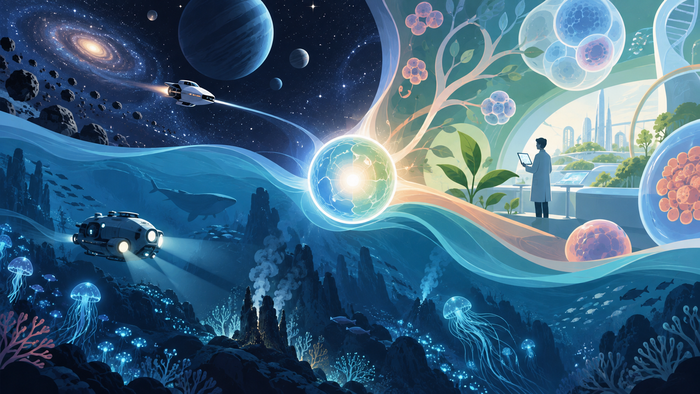 [코리안투데이] Poster for the Gwacheon National Science Museum special exhibition ‘Beyond Data: The Dark’ © 장형임 기자 |
The Gwacheon National Science Museum (Director Lee Chung-won) announced that it will hold the special exhibition 《BEYOND DATA: THE DARK》 from September 18, 2026 to August 16, 2027.
This exhibition is an integrated project that reconnects and reinterprets content introduced at different times — ‘The Invisible Universe,’ ‘From the Deep Sea to the Cosmos’ and ‘Future Animals’ — under the single question of what lies beyond the limits of data. Rather than lining up new material, it newly designs the connections and flow among existing exhibition resources, giving it a different character from other special exhibitions.
The exhibition begins from the recognition that there are clear limits to the world humans can observe and experience. The light people can see is only a fraction of the electromagnetic spectrum, the extreme environments of the deep sea and outer space are difficult to reach directly, and it is impossible to know what forms of life may exist in the future. Yet the message the exhibition seeks to convey is that humankind has not left these limits as mere ‘unknowns,’ but has continually widened the boundaries of the known through observation and exploration, reasoning and imagination.
The exhibition hall unfolds across four areas. The first, ‘The Invisible Unknown,’ addresses the limits of the senses, showing the process of observing and inferring from evidence the parts of the universe that cannot be seen with the eye — light beyond the visible spectrum, and dark matter and dark energy. The second, ‘The Unreachable Unknown,’ newly incorporates into this exhibition’s narrative the content of ‘From the Deep Sea to the Cosmos,’ jointly planned and produced with the Incheon Children’s Science Museum (Director Ahn Young-chun) and the Uljin National Marine Science Museum (Director Kim Oe-cheol), presenting how humankind has explored the extreme spaces of the deep sea and outer space through technology and pushed past its limits. In the third, ‘The Not-Yet-Come Unknown,’ the exhibition scientifically imagines the possibilities of future life on the basis of the principles of variation, selection, adaptation and evolution seen in life past and present.
After passing through these three areas, visitors arrive at the ‘Room of Perspectives.’ Through the differing viewpoints of William Herschel, Zhuangzi, Charles Darwin and Vera Rubin, it poses the question: is what we now see all there is to the world? Drawing on cases in which people measured invisible light, reflected on the boundaries of the world they observed, read the changes of life across vast stretches of time, and traced the marks of unseen mass in the motion of the stars, it revisits the ways in which humankind confronts the unknown. At the end of the exhibition, the question ‘What do you wish to know?’ is left behind, so that the pursuit of the unknown carries on into the visitor’s own questions.
The significance of this exhibition for visitors lies not in confirming correct answers. As each area flows in the sequence of ‘the unseen — the unreachable — the time not yet come,’ visitors experience discovering questions for themselves rather than being handed knowledge. The exhibition also tries out a mode of operation that extends the lifespan of content by connecting, integrating and reinterpreting existing exhibition resources from new perspectives instead of discarding them.
The director of the Gwacheon National Science Museum said, ‘The more we live in an age where AI quickly finds patterns and answers within vast amounts of data, the more important it becomes to ask what questions we will pose in a world where data is not yet sufficient,’ adding, ‘I hope this exhibition will give visitors the experience of looking beyond what is visible and discovering new questions of their own.’
지역 홍보대사 신청 기자양성과정 신청 코리안투데이 지부장 신청 코리안투데이 인천강화
THE KOREAN TODAY × WIA CODE
이 기사의 WIA Code

WIA Code 스캐너로 비추면 인터넷 없이 발행 사실과 위·변조 여부를 확인할 수 있습니다.
휴대폰 기본 카메라로 찍으면 스캐너 안내 페이지가 열립니다 — 기사 바로 열기
움직이는 코드(스트림) 한 장에 기사 전문(사진 포함)이 담겨 있습니다 — WIA Code 스캐너로 약 26초 비추면 폰에 저장되어 인터넷 없이도 읽을 수 있습니다. Stream.mp4 도 여기서 받습니다.
WIA Code · 코리안투데이


Leave a Reply