
The Incheon Metropolitan Government will expand its ‘Chemical Accident Safety Signal’ system, introduced to prevent chemical misinjection accidents, to private-sector workplaces beginning this year. Building on the experience of first applying it to 103 handling facilities at the Incheon Environment Corporation last year, the initiative is a prevention system that reforms the work environment itself so that even a momentary human error does not lead to an accident.
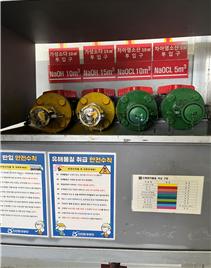 [코리안투데이] The Chemical Accident Safety Signal, applying dedicated colors to chemical storage tanks, piping and injection ports © 장형임 기자 |
The Incheon Metropolitan Government announced that it will expand the ‘Chemical Accident Safety Signal’, applied last year to 103 chemical-handling facilities across 13 workplaces of the Incheon Environment Corporation, to private-sector workplaces this year. The plan is to draw on the results accumulated at public facilities to establish application criteria and standard guidelines by industry and facility type, and to propose them as a new standard for national chemical safety management.
The Chemical Accident Safety Signal is a prevention system that applies a dedicated color for each chemical consistently from storage tanks through piping, valves and injection ports, and installs dedicated couplings so that injection hoses for different substances cannot be wrongly connected. The emphasis is on improving the work environment itself so that even if a worker is momentarily confused, that mistake does not lead to a misidentification, misinjection or cross-contamination accident.
The project grew out of a series of misinjection accidents that occurred in Incheon last year. In August of last year, at the Gongchon office of the Incheon Environment Corporation, sodium hypochlorite was mistakenly injected into an aluminum sulfate storage tank, injuring four workers; in September, at a semiconductor manufacturing plant in Michuhol-gu, sodium chlorate was wrongly poured into a hydrochloric acid storage tank, injuring 25 people. A split-second error in misidentifying the chemical and the injection port spread into the release of toxic gas and multiple casualties.
The city judged that there are limits to attributing these accidents solely to the carelessness of individual workers. Rather than merely demanding greater caution, it shifted its prevention policy toward equipping sites with visual identification systems and physical connection-blocking devices so that accidents do not follow even when people make mistakes.
According to the Chemicals Information System, a total of 49 chemical accidents occurred in Incheon between 2014 and 2025, killing 5 people and injuring 92. By cause, facility defects accounted for 23 cases and failure to comply with safety standards for another 23, together making up 93.9% of the total. In 2025 in particular, 8 accidents killed 1 person and injured 30, the highest casualty toll in the past 12 years.
Chemical accidents do not stem only from large-scale equipment failures. Leaked substances directly affect the respiratory tract and skin, and when reactive substances mix, toxic gases and intense heat can be generated, escalating into fire or explosion. Depending on a substance’s toxicity, the amount released, weather conditions and the surrounding environment, the impact can even reach residents’ living areas beyond the workplace. This shows that preventing chemical accidents is a matter of safety for the entire community, not just for a particular workplace.
Yet on-site marking systems differ from one workplace and facility to another. Even when a chemical’s name is prominently attached to a storage tank, piping may show only the direction of flow and valves only a management number, forcing workers to check separate drawings or work orders. In some cases the injection port bears no substance name, or only an old label remains, making immediate identification difficult. In such environments, even experienced workers can momentarily confuse piping or injection ports.
The Safety Signal applies the same color to the same chemical, marking it consistently from the storage tank through piping, valves and injection ports. Sodium hypochlorite is marked green, aluminum sulfate blue, and sodium hydroxide yellow, among others, so that substances can be identified intuitively throughout storage, transfer and injection. In addition, dedicated couplings prevent the piping and injection hoses of different substances from being physically connected. By varying the diameter, threading and pin or key positions of the connectors for each substance, the system blocks misinjection once more at the connection stage, even if the color or substance name is misread.
The project imposes no new legal obligations. The core is to keep in place the existing handling standards, warning labels, safety training, facility inspections and emergency-response systems required by current law, while adding visual identification and physical blocking devices to reduce the chance that human error leads to an accident.
Right after the chlorine gas accident at the Gongchon office in August last year, the city held an emergency meeting and drew up measures to prevent recurrence. It then conducted a full inspection of the handling facilities at 13 Incheon Environment Corporation workplaces from September 17 to November 6, 2025, and completed improvements at 103 facilities handling 15 chemicals including sodium hypochlorite, aluminum sulfate and sodium hydroxide. At each facility, substance names and dedicated colors were marked on chemical tanks and injection ports, nameplates and locking devices were installed at injection ports, safety data sheet storage cases were placed around the tanks, and rotating warning lights were set up to signal when a chemical is being injected.
Starting this year, the city is extending this experience to private workplaces that handle hazardous chemicals. On July 20, the city explained the purpose and application methods of the Safety Signal at a safety-management training session for local workplaces, and it offers site-tailored consulting to workplaces that wish to participate. Experts visit workplaces to review the substances handled and the storage and transfer processes, analyze the sections where misinjection could occur and the existing marking status, and propose color-marking and dedicated-coupling measures suited to each facility’s conditions.
The city plans to expand voluntary participation by private workplaces this year and, from 2026 through 2027, to accumulate results from field applications and establish application methods and maintenance standards by industry and facility type. After 2027, it will pursue the preparation of standard guidelines through consultation with relevant agencies. Over the medium and long term, it plans to petition the central government for institutional improvements so that the prevention measures verified in Incheon — introducing visual identification systems for each chemical, establishing consistent marking standards for storage tanks, piping, valves and injection ports, and applying dedicated couplings to prevent misinjection — are reflected in national safety-management policy such as laws and guidelines. The idea is for Incheon to lead a bottom-up prevention model that links locally occurring accidents to on-site improvements, verifies them first at public facilities, then spreads them to the private sector and develops them into a national system.
Yoon Eun-ju, head of the city’s Environmental Safety Division, said, ‘The Chemical Accident Safety Signal does not stop at asking workers to be more careful; it is a policy that improves the work environment and safety-management system together so that accidents do not follow even when a person is momentarily mistaken.’ She added, ‘We will expand the on-site verification that began at public facilities to private workplaces, and actively pursue the preparation of guidelines and institutional improvements so that Incheon’s experience can lead to a new standard for national chemical safety management.’
지역 홍보대사 신청 기자양성과정 신청 코리안투데이 지부장 신청 코리안투데이 인천강화
THE KOREAN TODAY × WIA CODE
이 기사의 WIA Code

WIA Code 스캐너로 비추면 인터넷 없이 발행 사실과 위·변조 여부를 확인할 수 있습니다.
휴대폰 기본 카메라로 찍으면 스캐너 안내 페이지가 열립니다 — 기사 바로 열기

움직이는 코드는 스트림입니다 — WIA Code 스캐너로 약 18초 비추면 기사 전문(사진 포함)이 폰에 저장되어 인터넷 없이도 읽을 수 있습니다.
WIA Code · 코리안투데이



Leave a Reply